Unlocking Private Equity for Shareholders
Systems Thinking
Marketplace Logic
Product Strategy
Fintech Compliance
End-to-End UX
Company
Liquidise
Industry
Fintech B2B
Timeline
Q2 2023 - Q4 2023

Liquidise is a fintech marketplace built to unlock liquidity for private shares. I led the design transition from a static registry into a secondary market, connecting digital cap-tables to real-time trading.
Liquidise held $800M in locked assets with no way for shareholders to sell or for the business to earn revenue. I had to design an instant, regulated marketplace to replace a slow manual process and prove the platform's commercial viability.
I designed the instant trading experience that enabled Australia’s first regulated secondary trade. This pilot with Kester Black validated our business model, reduced settlement from weeks to seconds, and featured in the AFR.
CEO & CTO (Founders)
Head of Product
1 PM, 4 Engineers
1 Product Designer (me)
UX Strategy
Product Mapping
Translating Financial Logic
Design Validation & QA
7 months (Concept to Pilot)

preface
Liquidise started its journey as Boulevard Global, a share registry that managed private assets via distributed ledger technology. It served as the central source of truth for companies, moving share management away from manual spreadsheets into secure digital ledgers.
I joined in March 2022 as the only designer. For the first six months, I focused on scaling the registry to manage records for nearly:
170+
companies
10,000+
shareholders
$800M~
worth shares
But there was a problem: that wealth was only on paper. Shareholders could see their value on a screen, but they couldn't actually do anything with it.
Six months after I joined, my role shifted. My job was to figure out how to turn this static registry into a live marketplace.

ProblemS
Within months of me joining, we hit a wall. While the platform was a successful database, it wasn’t a sustainable business. We were sitting on nearly $800M in private capital, but it was frozen and offering no way to grow the company or provide real value to shareholders.
User Problem
For our 10,000 shareholders, equity felt like a theoretical numbers game rather than real money.
Asset Rich, Cash Poor
Users could see their wealth on a screen but had no way to access it, often waiting years for an IPO.
The Manual Nightmare
Selling shares required weeks of legal paperwork and high admin fees that often cost more than the sale itself.
No Price Discovery
Shareholders had no way to know what their shares were actually worth, leaving them with zero control.
Business Problem
The original registry model had reached its ceiling. Keeping records was no longer enough to keep the company solvent.
Revenue Stagnation
Subscription fees couldn't cover the high cost of customer acquisition.
Zero Transactions
We were missing our biggest revenue opportunity: transaction fees from the $800M sitting on our platform.
Survival Risk
With a shrinking cash runway, the business needed a fundamental shift to attract new investment.
business validation & FUNDRAISING
To grow beyond a static registry and attract investment, I built a POC that acted as a bridge to funding. I mapped the trading logic and designed the investor decks to show how we would move from spreadsheets to a digital marketplace.
The concept tested demand by collecting buy-bids before opening a sell window. Settlement was manual and not guaranteed, sometimes participants only received a partial match, but it proved the concept was viable.
This work was the main driver in securing the strategic investor who acquired the company. While the prototype was retired after the deal, it wasn't a waste of effort. It gave us what we needed to rebrand to Liquidise and the funding to double our engineering team to hit our new 12-month roadmap.

Prototype Protected
under NDA
Secured Acquisition
The prototype and pitch decks were the catalysts for the investment.
Team Growth
The funding allowed us to scale from 2 to 4 Engineers.
The 12-Month Roadmap
Transitioned from "survival mode" to a fully funded, long-term product plan.
product MAPPING & Architecture
The POC proved demand but lacked instant, guaranteed settlement; it relied on matching buy-bids with sell-offers manually. To solve this, the founders looked to decentralised finance, specifically the Uniswap model of Automated Market Makers (AMM).
I led intensive workshops with the founders and the Head of Product to translate this high-level concept into a functional system. We had to figure out how to apply tokenisation to private equity while ensuring settlements were instant and guaranteed. I mapped the entire journey from the trading algorithm and market strategy to the internal movement of funds.
The 2-Stage Trading Journey
To ensure guaranteed liquidity, a two-stage approach was needed for secondary trading.
1
Build up the share pool
A window for shareholders to offer equity to seed the marketplace.
2
Instant settlements (AMM)
Real-time trading powered by the AMM and a cash pool removing the need for manual matching.

Journey Map for Liquidise.
(In this case study, I focus solely on existing shareholders)
I developed a Fund Flow Schema to map exactly how capital and equity moved across the platform. This was critical because the AMM model introduced high financial complexity that required a clear blueprint before any code was written.

Fund Flow Schema
By visualising these flows, I aligned our technical, legal, and product teams on a single source of truth. This schema didn't just accelerate development; it became a core piece of our investor strategy, proving we had a scalable, compliant architecture for instant settlement.
Explorations
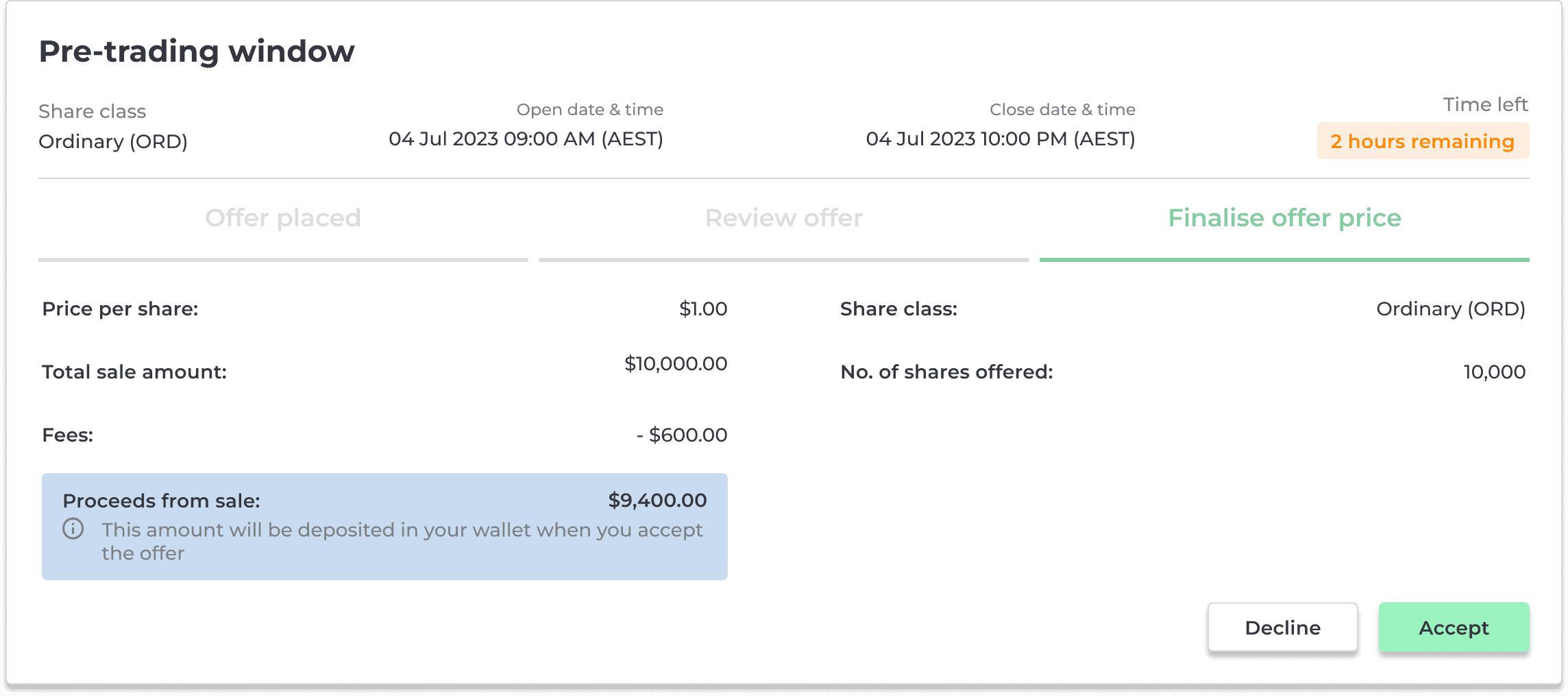
To run the AMM, we first had to build a guaranteed pool of shares. I turned the "Build up share pool" step from our journey map into this functional flow to test the logic, which we called the Pre-trading window. This let us see how it actually felt for a user to move their equity into the system for the first time.


Iteration 1
The Pre-trading window was the main UX challenge. While the backend handled instant settlement, this was a complex journey that needed the most design focus, and we had to get it right. Crucially, this was the first time users actually interacted with the platform instead of just viewing their equity in the registry.
My core Strategy
Prioritising user trust over technical novelty through an "Invisible Blockchain" approach.
Hiding the Tech
I used AUD and removed all crypto-jargon. I wanted the experience to feel like a simple familiar app.
Removing Uncertainty
I made prices and fees unmistakable. I had to ensure the core math worked before adding complex UI layers.
Speed to Validation
I reused existing components to get a functional version in front of the founders for quick feedback.
I presented these flows in weekly sessions with the team, board, and investors to stress-test the logic. Their feedback helped move the design from abstract wireframes to a high-trust trading experience.
Providing context for high-stakes actions
Internal walkthroughs revealed that the interface was too opaque for such a high-stakes task. Without clear feedback, turning equity into cash felt uncertain. To fix this, I introduced Information Boxes to give users immediate context on their current state and clarify exactly what action was required next.
Internal walkthroughs showed the process of turning equity into cash felt too opaque. I introduced Information Boxes to provide immediate state-awareness and clarify the specific action required to move forward. [Visual: Close-up of Info Boxes/Contextual UI]

Iteration 2

Eliminating redundant naming
Internal feedback showed that the label "Pre-trading window" which was to be followed by a "Trading window", was redundant and confusing for users. We renamed the phase to Sell-auction to create a sharp distinction between the initial pooling stage and the live market
Feedback showed that "Pre-trading" followed by "Trading" was repetitive and lacked a clear distinction. We explored several iterations—including Early selling window and Initial selling window—but the team agreed they still weren't clear enough. We eventually landed on Sell-auction to create a sharp, functional distinction between the initial pooling stage and the live market.
Feedback showed that "Pre-trading" followed by "Trading" was repetitive and lacked clear distinction. We renamed the phase to Sell-auction to clearly separate the pooling stage from the live market.
Translating technical states into a clear journey
I mapped every stage an offer travels through, from the initial sell offer to the final settlement price. I translated these backend stages into a Timeline Stepper and a State-Aware UI. This ensured the user always knew where they stood in the transaction, removing the "black box" feel of the automated algorithm.
I mapped the entire offer lifecycle—from creation to final settlement—into a Timeline Stepper. This translated complex backend stages into a predictable roadmap, ensuring the user never felt lost in the "black box" of the algorithm. [Visual: Timeline Stepper / State-Aware UI variations]


Final Design
Stage 2: Facilitating Instant Settlements
Once the logic for the Sell-auction was solidified, I mapped the user flows for the Live Trading window. This phase was the core value proposition of Liquidise: moving from manual, uncertain matching to a high-frequency, automated marketplace.

The primary challenge was to make the backend complexity of the Automated Market Maker (AMM) feel invisible and real-time. I focused on real-time transparency, ensuring every algorithmic price change was immediately understandable and actionable.

Managing Visual Hierarchy
To prevent the UI from becoming overwhelming on the web, I introduced collapsible cards to the design system. This allowed the now closed Sell-auction details to tuck away, keeping the user’s focus entirely on the active trade and ensuring the execution interface remained above the fold. This created a natural progression from "sell-auction" to "trading", while ensuring the most critical actions were always visible without scrolling.

Handling Constraints & Edge Cases
I had to account for high-stress edge cases, such as price shifts happening while a user was mid-decision. I originally proposed a 90-second price-lock to give users certainty before committing to a trade.
I originally proposed a 90-second price-lock to give users certainty mid-decision. However, a technical walkthrough with engineering revealed that locking prices would disrupt the liquidity pools and create significant financial risk for the platform.

However, a technical walkthrough of the Automated Market Maker (AMM) revealed that locking prices for that long would disrupt the liquidity pools and create significant financial risk for the platform.
I moved to a model where the AMM would re-check the price the exact second a user hit "Accept". If the market moved, the UI would catch it, show the new price, and require a fresh confirmation.
I pivoted to a "Re-check on Accept" model. The UI now verifies the price the millisecond a user hits "Accept." If the market moves, the interface catches it instantly, shows the update, and requires a fresh confirmation. This balanced user needs with the mathematical reality of the AMM.

Additionally, because the share pool is unpredictable, I designed specific states for when insufficient shares were available to fulfil a requested trade amount. This turned a technical limitation into a clear user expectation, informing the user exactly why a trade might be partially filled or unavailable before they committed.

Designing "Positive Friction"
In a 30-second trading environment, speed is vital, but accidental trades are a legal nightmare. I introduced intentional Positive Friction to ensure every trade was a conscious, binding decision:
Strategic Spacing: I physically separated "Decline" and "Accept" buttons to prevent errors during high-activity periods.
The Mandatory Checkbox: I added a final confirmation checkbox that must be ticked before a transfer can start. This acts as a cognitive "speed bump," forcing the user to verify the final AUD price one last time before committing.

Making settlement instant and secure
While our trading platform was built to be instant, traditional bank transfers can take days to clear—a delay that creates user anxiety and kills momentum. Because the original share registry couldn't handle money, I had to build a wallet that allowed users to have funds ready before they traded.
I led this initiative from concept to execution in just two weeks, working closely with an engineer while continuing to ship other features. By integrating the Monoova API, I created a system where funds could be pre-loaded and verified, ensuring that when a user clicked "Buy," the settlement happened immediately.
Operating under an AFSL, I built the digital wallet to handle all legal requirements directly within the user’s journey:
1
Integrated Verification
The wallet stays locked until the user’s identity is fully verified. This keeps the platform safe and meets all legal standards without needing manual checks.
2
Automatic Ownership
I designed the system to handle the heavy lifting in the background. The moment a trade happens, it automatically moves the money, updates the share registry, file ASIC forms and issues the legal certificates.
3
Verified Links
To make sure money only goes to the right person, I designed a simple verification step where we send $0.01 to the user’s bank account to confirm they own it before any big trades happen.
While our trading platform was built for speed, traditional bank transfers can take days to clear—a delay that creates user anxiety and kills momentum in a live market. To bridge this gap, I led the design of a Pre-funded Digital Wallet.
I took this initiative from concept to execution in just two weeks, collaborating closely with a single engineer. By integrating the Monoova API, I created a system where funds could be verified in advance, ensuring that when a user clicked "Buy," the settlement happened the moment the trade was accepted.
Designing for Compliance and Trust
Operating under an AFSL meant the wallet had to handle rigorous legal requirements. I focused on weaving these into the user journey so they felt like security features rather than bureaucratic hurdles:
1. Seamless Identity Verification
To meet legal standards without manual bottlenecks, I designed an Integrated Verification flow. The wallet remains locked until the user’s identity is fully verified. By providing clear feedback on "Verification Status," we kept the platform safe while managing user expectations about when they could start trading.
2. Automating the Post-Trade "Paperwork"
I designed the system to handle the heavy lifting of ownership in the background. The moment a trade executes, the UI reflects the change instantly, while the system automatically updates the share registry, files necessary ASIC forms, and issues legal certificates. This removed the "administrative tax" from the user experience.
3. The "Penny-Drop" Verification
To ensure capital only moved to authorized accounts, I implemented a simple Verified Links step. We send $0.01 to the user’s bank account to confirm ownership before any high-stakes trades occur. This small "speed bump" significantly increased user confidence, proving the system was secure before they committed larger sums of capital.

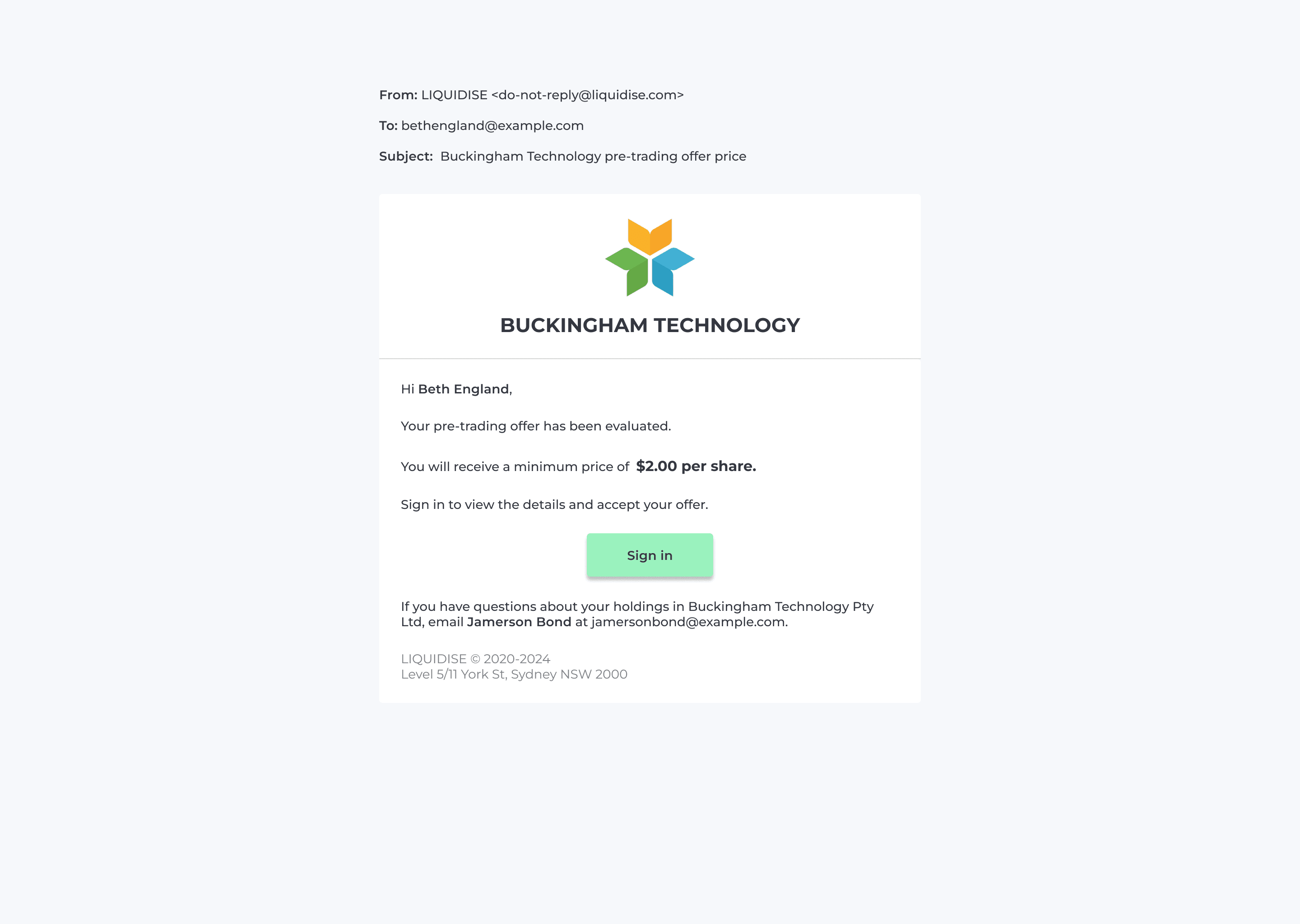
Since these trading windows were time-sensitive and high-stakes, I designed email notifications to guide users through the journey. This ensured they didn't have to constantly check the dashboard or risk missing a window, while also helping reduce anxiety throughout the decision-making process.
Since the trading windows were time-sensitive and high-stakes, I designed a notification strategy to guide users through the journey. These weren't just alerts; they were a way to maintain continuity of experience outside of the platform.
Reducing "Refresh Anxiety"
By mapping email triggers to key milestones—like the start of a Sell-auction or a final settlement—I ensured users didn't have to constantly monitor the dashboard. This removed the pressure of "missing the window," allowing for a more composed and confident decision-making process.
The Email as an Audit Trail
In a new and complex market, trust is built through documentation. I treated these notifications as Digital Receipts, providing immediate, written confirmation of trades, prices, and settlements. Surfacing this data directly in the inbox provided a permanent record for the user and significantly reduced potential support overhead by answering "what happened?" before the user had to ask.

Implementation & Internal Testing
To ensure the platform could handle the pressure of a live liquidity event, I partnered with the PM to lead internal testing in our QA environment. We ran multiple high-stress simulations, from the initial Sell-auction through to the final settlement, to identify friction points before the pilot launch.
Engineering Efficiency through Design Systems
To accelerate implementation, I leveraged the React MUI design system I had built from the ground up. By adhering to these established patterns, I ensured the engineering team could prioritize complex backend logic over building new UI components. Because the system was built to be scalable, we introduced new components only when necessary for unique trading needs, allowing us to scale functionality rapidly without increasing front-end debt.
The Strategic Value of Backend-Agnostic Design
I made a deliberate choice to design the interface so it wasn't tied to any specific backend technology. In a regulated startup environment, I knew we might need to pivot our underlying systems as the product evolved.
This decision proved critical during internal testing. We found that the original Ethereum-based setup was too slow for high-frequency trading, causing delays that would have frustrated users. Because the UI and logic were independent of the backend, we were able to switch the entire system to the Redbelly Network for faster processing with zero updates to the interface. This saved the team weeks of rework and kept our pilot launch on track.
Designing for "Wealth in Transit"
Since blockchain settlement isn't instantaneous, I had to solve for the "In-Between"—the high-anxiety period where a user’s wealth is being converted from shares to cash.
Calibrating the Experience: I worked with the PM to define window parameters, such as timing and price ceilings/floors, then calibrated the UI to match actual blockchain speeds.
Managing Psychological Safety: I designed "Settlement Buffers" and real-time status updates into the UX. By providing a clear, visual roadmap of the settlement progress, I ensured users felt secure and informed while their assets were in transit.
Collaborations
A designer is only as good as their ability to get things built. This pilot succeeded because I acted as the strategic bridge between the technical constraints of the blockchain and the commercial goals of the business.
Product Alignment
I worked closely with Product Management to move from abstract concepts to validated mockups at high speed. My focus was on ensuring that every feature, while meeting strict regulatory and business requirements, remained centred on the actual needs of our 1,700+ investors.
"Fawaz is a talented designer that I had the pleasure of working closely with at Liquidise. He has the ability to take ideas from concept stage into mockups at speed. What sets Fawaz apart is his genuine ability to understand the needs of our users to ensure that our features were not only visually appealing but also user centric. He was responsible for designing and updating our app's entire interface and most recently worked on revamping our website. Fawaz is humble, a fast learner and would be an excellent contributor to any team."

Victoria Tran
Product Manager
"Fawaz is a flexible and talented designer with an eye for detail and an open nature as is required for startups. Working with him has been a breeze and he would be a solid addition to any product team."

Brendan Murty
Lead Software Engineer
Engineering Partnership
In a startup environment, technical literacy is non-negotiable. By overseeing the entire design system and maintaining an open, collaborative relationship with the engineering team, I ensured that our high-fidelity mockups were ready for immediate implementation.
"Fawaz is a diligent and innovative designer who bridges product vision and user experience with elegant, intuitive designs. At Liquidise, his ability to oversee the entire design system, be readily accessible and maintain a calm presence was inspiring. Fawaz would be an invaluable addition in elevating design systems, team collaboration and user engagement."

Baljinder Singh
Software Engineer

Outcome
The Kester Black pilot was the first live test of the Liquidise platform. In under seven months, we moved from concept to a regulated digital marketplace, condensing a weeks-long manual settlement process into a sub-30-second automated experience. This wasn't just a technical launch; it was the first time a private company in Australia facilitated secondary share trading through a fully automated digital marketplace.
Kester Black, a sustainable Australian beauty brand, had 1,700+ retail investors from a 2020 crowdfunding raise. By 2024, many shareholders sought liquidity for personal expenses like rising mortgages and school fees. Founder Anna Ross described managing these trades manually as "onerous and complex." Liquidise was designed to automate this administrative burden while ensuring regulatory compliance.
Zero-Failure Execution
1,700+ participants navigated the marketplace with zero reported accidental trades. This validated that the “Positive Friction” patterns effectively mitigated the risk of user error in a high-velocity environment.
Reliability
100% success rate
0 settlement failures
Shareholders
1,700+ Participants
Regulatory Breakthrough
By facilitating error-free trades for a large retail base, the design provided the "Proof of Safety" required to validate the automated AMM model for regulators, de-risking the platform for future market expansion.
Operational Efficiency
We proved that a process previously requiring days of manual legal and spreadsheet coordination could be executed instantaneously without sacrificing security.
Settlement Speed
Reduced from weeks to < 30 seconds
Trade Volume
$70,000+ completed in the pilot
Trust by Design
The combined experience of the digital wallet, the "Re-check on Accept" price logic, and the notification audit trail provided the security needed for users to confidently trade their equity.


Reflection
High-stakes fintech is not e-commerce. You aren’t just moving pixels; you’re moving life savings. During the Liquidise pilot, I managed the complexity of a new financial market by prioritizing data transparency and regulatory integrity over traditional "frictionless" design.
1
Infrastructure-First Design
I learned that the most critical UX roadblocks often exist deep in the backend, specifically bank delays and blockchain latency. My focus shifted from the interface to the financial logic, designing systems like the pre-funded wallet to bridge technical gaps before they ever reached the user.
2
Resilience as a Business Strategy
A backend-agnostic design system is a strategy for business continuity. By decoupling UI logic from the tech stack, we successfully pivoted from Ethereum to Redbelly with zero interface updates, saving weeks of rework and securing our launch date.
3
Compliance is a Trust-Builder
ASIC and AFSL requirements are design tools, not roadblocks. Integrating compliance like “Positive Friction” in the trading window transforms regulatory “speed bumps” into signals of safety, preventing high-anxiety errors and building user confidence.
4
Translating Logic into Experience
Translating Automated Market Maker (AMM) math into a human experience requires constant cross-functional alignment. I learned how to balance mathematical accuracy with user-friendliness by facilitating a tight feedback loop between the founders, engineering, and legal teams.
Designing for Liquidise wasn't about making a "trading app", it was about designing a system of trust.
Successful product design in fintech requires a deep respect for the "invisible" layers - legal requirements, blockchain latency, and the anxiety of the user.
By embracing these constraints rather than fighting them, we built a platform that proved secondary markets for private equity aren't just possible, they’re inevitable.
"In high-stakes fintech, clarity is a security feature. By being transparent about how the auction and trading windows worked, we turned a confusing technical process into a reason for users to trust the platform."